What Does It Mean for TILOS to Be the Standard in Time-Location Planning?
Date: 25.10.2026
Author: Adam Gajewski
Minutes: 9 min
Article

Why product capability, technology foundation and user practice must stay connected
Through the years, TILOS has become a standard tool for time-location planning in complex infrastructure projects.
From the beginning, Human Dialog has stood behind the technology that made TILOS possible — developing and maintaining the foundation on which its planning capabilities were built. Over the years, we have watched the tool evolve in the hands of practitioners and become part of their planning DNA.
This experience has shown us that when a tool becomes an industry standard, the challenge is no longer only how to develop the product, but how to define the responsibility that comes with its position.
At Human Dialog, we believe that a true standard becomes part of the professional practice around it. It both influences and is influenced by how planners think, how project teams communicate, how organizations structure planning knowledge, and how complex projects are understood over time.
This responsibility therefore has more than one dimension. The producer must protect the technology foundation and support future development. But the future of a standard should also remain connected to the experience of the people who use it in real projects.
That is why Human Dialog is opening TILOS Innovation Hub- communication channel around TILOS continuity, usability and future development.
We want this dialogue to help connect the technology behind TILOS with the practical experience of planners, schedulers, project controls specialists and organizations using TILOS in real infrastructure projects.
The future of TILOS-related development cannot be reduced to visible functionality alone. It must connect three elements:
- Product capability — the practical depth users rely on in real planning work.
- Technology foundation — the architecture that supports performance, scalability, continuity and future development.
- User practice — the workflows, libraries, standards, reporting practices and project experience built around TILOS over years of use.
Together, these elements define more than software. They define the continuity of an industry standard.
This article looks at what that means in practice: why a standard must protect critical capability, why technology continuity matters, how practical user experience should shape meaningful improvements, and why responsible evolution must be built through dialogue with the people who use TILOS in real projects.
Industry Standard Continuity Triangle
A tool that becomes an industry standard develops a specific dependency structure.
Its continuity depends on three connected pillars: product capability, technology foundation and user practice.
We can describe this as the Industry Standard Continuity Triangle.
The model is simple. But simple does not always mean easy. A standard remains trusted when capability, technology and user practice stay connected. If one pillar weakens, the others are affected.
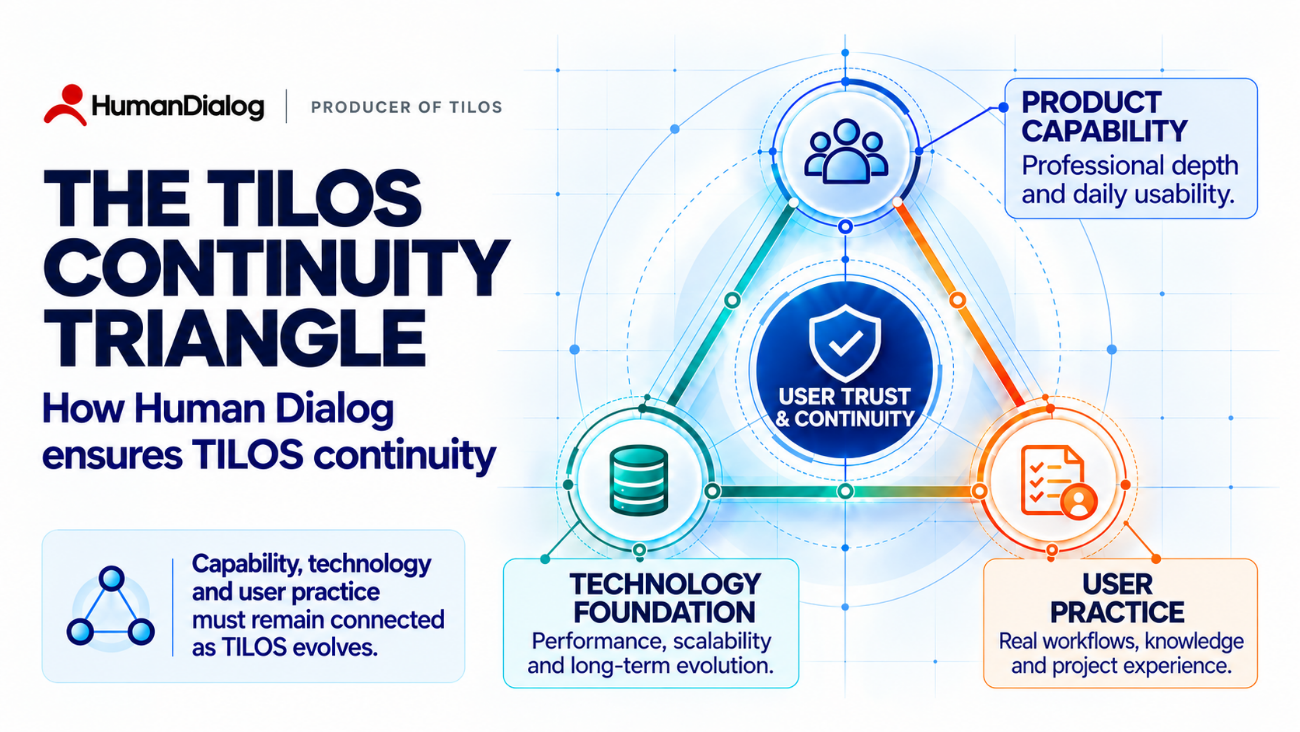
This is why an industry standard cannot be assessed only by its visible features. It is easier to understand if you think of a new tool produced for the domain, it may reproduce parts of the visible layer, but it does not automatically carry the technology foundation or the user practice built around an established standard.
For a standard tool, continuity is not only about keeping access to a product. It is about keeping these three pillars connected while the tool evolves.
A standard becomes part of professional practice
When a tool becomes widely adopted in a specialized field, its value grows beyond the application itself.
Planners develop ways of working around it. Organizations build internal standards, templates, libraries, reporting methods and links to ecosystem. Project teams learn how to interpret its outputs. Management becomes familiar with the way it communicates project logic, progress and risk.
Over time, the tool becomes part of the organization’s planning language.
Time-location planning is a very specific technical domain that uniquely connects with IT ecosystems, company processes and project workflows. It creates a one-of-a-kind feedback mechanism between planner work, organizational knowledge, project delivery methods and the way teams communicate around complex plans.
Therefore, it is essential for companies and planners to have confidence in the continuity and evolution of the system that carries this knowledge and experience.
This knowledge is a critical asset. It should remain connected to future development, future capability and future improvement.
A standard must protect critical capability
During the evolution of a standard, especially one built for a complex professional domain, there is often a strong expectation to reduce complexity and make the tool easier to use.
At Human Dialog, we believe the right question is not only: How can the tool become easier to use?
The better question is: How can the tool become easier to use while protecting the capabilities, scalability and planning expertise that users cannot afford to lose?
For an industry standard, evolution should not be a trade-off between usability, capability and scalability. Especially in complex professional domains, simplification creates value only when it helps users work more effectively without limiting the ability to model real project complexity.
Over time, a standard tool may need better usability, clearer workflows, more modern interfaces and easier access to information. But evolution cannot mean reducing the depth that made the tool valuable in the first place.
It must be usable by a single planner working on a smaller project, but it must also be capable of supporting enterprise-level planning environments, complex workflows and mega projects where large amounts of project information, reporting needs, interfaces and planning logic have to be managed reliably.
Scalability really matters.
A tool that works well for a simple case may still fail when exposed to the realities of major infrastructure delivery: multiple teams, large datasets, changing baselines, detailed progress updates, libraries, calendars, integrations, reporting requirements and organizational standards.
For an industry standard tool like TILOS, evolution should therefore not mean becoming lighter at the cost of capability. It should mean making complex capability easier to use, easier to share and easier to apply at different levels of project maturity.
A standard must respect user practice
A standard tool grows through user experience.
Every project adds knowledge: planning methods, workarounds, templates, libraries, reporting habits, progress update routines, integration practices and lessons learned from real delivery.
This knowledge is not only stored inside the software. It lives in organizations, teams, standards, habits and professional experience.
For a standard to evolve responsibly, this practical knowledge should become an input to future development.
The question is not only: What new functionality can be added?
The better question is: How can the tool evolve in a way that strengthens the planning knowledge users have already built?
This is where user expertise and producer expertise meet. This is where the community plays a crucial role.
Planners, schedulers, project controls specialists and project teams understand how the tool is actually used under project pressure. They know which capabilities are essential, which workflows create value, and which improvements would make the tool more effective in daily work.
A standard should not evolve away from this knowledge. It should use it as one of the foundations for meaningful improvement.
A standard needs technology continuity
A standard also needs a technology foundation that can continue beyond visible product releases.
Roadmaps, features and user interface improvements matter, but they are only the visible layer. Underneath them there must be architecture capable of supporting performance, scalability, data continuity and future development.
This is where Human Dialog has a unique role as a producer.
Human Dialog is the original engineering team behind TILOS. To create TILOS, we did more than build another application. We developed and continue to maintain the technology platform — today known as ObjectReef — that provides the foundation for performance, scalability and long-term continuity.
For a tool that has become part of professional planning practice, this technology responsibility matters.
With the right technology foundation, existing capability can be protected while new capabilities are developed in a controlled and sustainable way.
Without the technology foundation, even strong product ideas become harder to maintain, extend and scale.
Technology continuity is therefore not only an internal technical matter. It is part of what allows users and organizations to trust that the standard can continue to evolve without losing its depth, reliability or ability to support demanding project environments.
A standard should evolve through dialogue
The future of an industry standard tool should not be shaped only by internal assumptions or abstract product ideas.
It should be shaped through a feedback mechanism that connects the industry knowledge of users and the technology knowledge of the producer.
Users understand how planning works in real projects. They know where the tool creates value, where it creates friction, where project needs are changing and what should continue to be supported.
The producer understands how these needs can be translated into reliable, scalable and fit-for-purpose technology.
Only when these two perspectives work together can a standard evolve responsibly.
This is why dialogue with users is not only communication. It is part of responsible product development.
For Human Dialog, user dialogue is not a symbolic gesture. It is a practical mechanism for understanding how TILOS is used today, where continuity matters most, and which improvements or new capabilities should shape its future.
Human Dialog’s role
At Human Dialog, we believe that the future of TILOS development should be built on three connected foundations: technology continuity, real project experience and practical development.
As the original engineering team behind TILOS, Human Dialog brings deep knowledge of the technology foundation. We bring to this discussion 30 years of technological development and experience with Tilos evolution.
But technology knowledge alone is not enough. Our company name, Human Dialog is not a coincidence, we have the dialog in our DNA.
We believe the future must be shaped through direct dialogue with users, planners, schedulers and time-location planning practitioners.
Our commitment is to support continuity, develop future TILOS capabilities, and create a stronger connection between the people who use TILOS and the development direction that should shape what comes next.
The role of Human Dialog is therefore not only to maintain technology. It is to connect technology continuity with user knowledge and future development.
This connection is essential for the future development of TILOS, it is to protect what users already rely on while creating meaningful improvements for the years ahead.
Join the Future of TILOS
So when we ask what it means to be the standard in time-location planning, the answer cannot be limited to functionality.
- It means responsibility for technology.
- It means respect for user practice.
- It means protecting critical capability.
- It means supporting scalability from individual planning work to enterprise-level project environments.
- It means continuous dialogue with real project practice.
- It means evolving without losing what made the standard valuable in the first place.
If TILOS is part of your planning environment, we invite you to join the discussion and share your perspective
What should a standard in time-location planning mean to you?